In modern construction, especially in drywall and partition systems, studs and tracks are fundamental framing components. Although they are often mentioned together, they serve distinct structural roles. Understanding the difference between studs and tracks is essential for builders, contractors, and anyone involved in light steel framing or interior construction.
What Are Studs?
Studs are vertical framing members used to form the skeleton of walls and partitions. Typically made from galvanized steel or wood, studs provide the primary support for wallboards such as gypsum panels.
Key Characteristics of Studs:
- Orientation: Installed vertically between the floor and the ceiling
- Function: Provide structural support and load distribution
- Shape: Usually “C-shaped” in steel framing
- Spacing: Commonly placed at 16 or 24 inches (400mm or 600mm) on center
- Applications: Interior partitions, exterior walls, and load-bearing structures (depending on material)
Steel studs are widely used in commercial construction due to their fire resistance, dimensional stability, and resistance to pests and moisture.
What Are Tracks?
Tracks are horizontal framing components that act as guides or channels for studs. They are installed at the top (ceiling track) and bottom (floor track) of a wall structure.
Key Characteristics of Tracks:
- Orientation: Installed horizontally
- Function: Hold studs in position and define wall alignment
- Shape: Typically “U-shaped” channels
- Placement: Fixed to floors and ceilings before inserting studs
- Applications: Used in conjunction with studs in partition systems
Tracks do not usually bear vertical loads themselves; instead, they stabilize and align the stud system.
Main Differences Between Studs and Tracks
Understanding the distinction between these two components is critical for proper installation and structural integrity.
1. Orientation and Position
- Studs: Vertical members forming the wall framework
- Tracks: Horizontal channels at the top and bottom of the wall
2. Structural Role
- Studs: Provide primary support and load-bearing capacity
- Tracks: Serve as guides to secure and align studs
3. Shape and Design
- Studs: C-shaped with flanges and a web
- Tracks: U-shaped channels without return lips
4. Installation Process
- Tracks are installed first and anchored to the building structure
- Studs are then inserted into the tracks and secured
5. Load Distribution
- Studs transfer vertical loads from ceilings or upper floors
- Tracks distribute loads laterally and maintain positioning
How Studs and Tracks Work Together
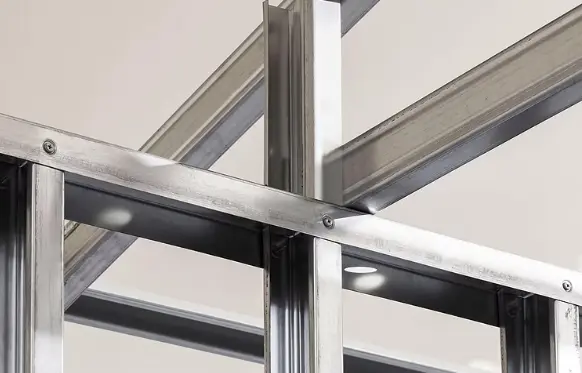
Studs and tracks form a complete framing system. The process typically follows these steps:
- Install the bottom track along the floor line
- Install the top track aligned with the ceiling
- Insert studs vertically into the tracks
- Secure studs using screws or fasteners
- Attach drywall or other finishing materials
This integrated system ensures structural stability, alignment accuracy, and efficient load transfer.
Materials Used in Studs and Tracks
Both components are commonly made from:
- Galvanized steel: Preferred for durability and corrosion resistance
- Wood: Used in residential construction for cost-effectiveness
- Aluminum (less common): Used in specialized lightweight structures
Steel framing systems are increasingly popular due to their consistency, recyclability, and compliance with modern building codes.
Common Applications
Studs and tracks are widely used in:
- Office partitions
- Residential interior walls
- Commercial buildings
- Drywall systems
- Suspended ceilings (track variants)
Their modular nature makes them ideal for fast, scalable construction projects.
Why Understanding the Difference Matters
Confusing studs and tracks can lead to installation errors, structural weaknesses, and increased costs. Proper knowledge ensures:
- Correct material selection
- Efficient construction workflow
- Compliance with engineering standards
- Improved safety and durability
Conclusion
The difference between studs and tracks lies in their orientation, function, and structural role. Studs act as the vertical backbone of a wall, while tracks provide the horizontal framework that holds everything in place. Together, they form a reliable and efficient system used across modern construction projects.
For contractors and builders, mastering the use of studs and tracks is essential for delivering high-quality, code-compliant structures.
Post time: Apr-17-2026