When designing steel buildings or large-span structures, a common question arises: what is the difference between a bar joist and a truss? While both are structural framing systems used to support roofs and floors, they differ significantly in design, manufacturing, application, and load capacity. Understanding these differences helps architects, engineers, and contractors select the most efficient and cost-effective solution for their projects.
What Is a Bar Joist?
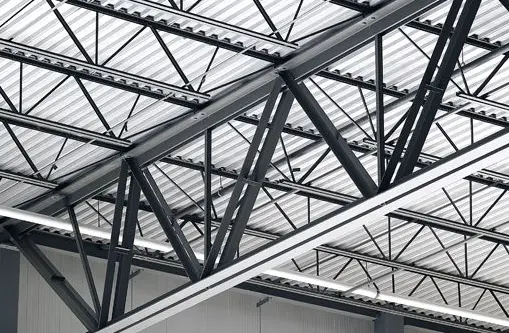
A bar joist, often referred to as an open-web steel joist, is a lightweight structural member used primarily in commercial and industrial buildings. Bar joists are typically fabricated from steel angles or rods welded together to form a web system between top and bottom chords.
In North America, bar joists are commonly manufactured according to standardized specifications set by the Steel Joist Institute (SJI). These standardized profiles allow for efficient mass production and predictable load performance.
Bar joists are widely used to support:
-
Flat or low-slope roofs
-
Floor systems in multi-story buildings
-
Mechanical equipment loads
They are generally spaced at regular intervals and supported by steel beams or load-bearing walls.
What Is a Truss?
A truss is a structural framework composed of interconnected triangular units designed to distribute loads efficiently. Trusses can be constructed from steel, wood, or aluminum, depending on the application.
Unlike bar joists, trusses are typically custom-designed for specific spans, loads, and architectural requirements. They can support longer spans and heavier loads, making them suitable for:
-
Large warehouse roofs
-
Agricultural buildings
-
Aircraft hangars
-
Residential roof framing
The triangular configuration provides high structural efficiency, minimizing material usage while maximizing strength.
Key Differences Between a Bar Joist and a Truss
Although both systems use open-web configurations, several important differences distinguish them.
1. Standardization vs. Customization
Bar joists are standardized structural components with predefined load tables. This standardization simplifies design and reduces engineering time.
Trusses, by contrast, are usually custom-engineered for specific projects. Their dimensions, web patterns, and load capacities vary depending on structural requirements.
2. Span Capability
Trusses typically accommodate longer spans than bar joists. While bar joists commonly span between 20 to 60 feet (6 to 18 meters), steel trusses can exceed 100 feet (30 meters) or more in large industrial applications.
3. Structural Depth
Trusses generally have greater depth relative to span, providing enhanced load distribution. Bar joists are shallower and optimized for lighter roof and floor loads.
4. Cost Efficiency
Bar joists are often more economical for standard commercial buildings due to mass production and predictable specifications. Trusses may involve higher engineering and fabrication costs but offer superior performance for specialized or large-span projects.
5. Installation Complexity
Bar joists are typically lighter and faster to install, making them ideal for repetitive framing systems. Trusses, particularly large custom steel trusses, may require cranes and specialized installation procedures.
Applications in Metal Buildings
In pre-engineered metal buildings, both systems are commonly used. Bar joists often support flat roof decks, while trusses are frequently used in gable-style or clear-span structures.
For example:
-
Retail stores and office buildings often use bar joists.
-
Warehouses and manufacturing plants may rely on steel trusses for wide column-free interiors.
Choosing between the two depends on span requirements, budget constraints, and architectural design goals.
Which One Should You Choose?
If your project requires a cost-effective, standardized solution for moderate spans, bar joists are typically the better option. If you need long clear spans, heavy load capacity, or unique roof geometry, a custom-designed truss may be more appropriate.
Consulting a structural engineer ensures that load calculations, deflection limits, and building code requirements are properly addressed.
Conclusion
So, what is the difference between a bar joist and a truss? A bar joist is a standardized, lightweight steel framing member commonly used in commercial construction, while a truss is a custom-designed structural framework capable of supporting longer spans and heavier loads. Both play vital roles in modern construction, and selecting the right system depends on project specifications, structural demands, and budget considerations.
Post time: Feb-28-2026